// INDEX_
The cultural pressure to "bounce back" mere weeks after childbirth is one of the most destructive narratives in modern fitness. Your body is not "out of shape"—it has undergone an extreme physiological and biomechanical transformation that requires engineering precision in recovery, not just mindless calorie burning.
As a Sports Scientist specializing in female biomechanics, having guided dozens of women through the LuKul postpartum strength-restoration framework, I witness the same dangerous tendency: a premature return to running, plyometrics, and traditional abdominal exercises. Such an approach not only delays recovery but can permanently damage the pelvic floor and exacerbate diastasis recti.
The "Bounce Back" Illusion and the Relaxin Trap
In commercial gyms, I frequently hear trainers advise: "Just start lightly with a cardio program on the treadmill." This is biologically reckless. The primary culprit for injuries during this period is the hormone relaxin.
During pregnancy, relaxin levels rise dramatically to loosen ligaments and prepare the pelvis for childbirth. What commercial trainers fail to mention is that clinical studies demonstrate the effects of relaxin on ligamentous laxity remain elevated for 3 to 12 months postpartum, particularly in women who breastfeed.
Jumping, running, or HIIT workouts during this window create massive ground reaction forces. When your ligaments cannot stabilize the joints, these impact forces transfer directly to the knees, lower back, and an already weakened pelvic floor, drastically increasing the risk of prolapse and Pelvic Girdle Pain (PGP). The correct response to joint hypermobility is not cardio; it is strictly controlled strength training to build a muscular "armor" around vulnerable joints.
Diastasis Recti: Anatomy of the Gap and New Clinical Data
Diastasis Recti Abdominis (DRA) is not simply a "gap in the stomach." It is the lateral separation of the right and left halves of the rectus abdominis muscle due to the thinning and stretching of the connective tissue (linea alba).
The latest meta-analyses from 2025 and 2026 (such as the studies by de Oliveira and Capoccia Giovannini) unequivocally confirm: structured, conservative exercise programs safely and effectively reduce Inter-Recti Distance (IRD). However, the core issue is not merely the width of the gap, but the loss of tension. If the connective tissue cannot transfer force, your spine and internal organs are left without their primary structural support.
Self-Assessment Test (Perform only with medical clearance)
Lie on your back with your knees bent. Slowly lift your head as if initiating a crunch. If you feel softness or see a bulge (doming) along the midline of your abdomen where your fingers can sink deeply, your force-transfer system is compromised. This is a clinical indicator that your physical architecture requires a Master Coach, not a group fitness class prescribing endless planks.
Managing Intra-Abdominal Pressure (IAP)
The fitness industry has demonized traditional curl-ups, claiming they will "tear" your stomach. Formal clinical science (Gluppe et al., 2023) dictates otherwise: curl-ups are actually safe, but only if you possess the ability to control Intra-Abdominal Pressure (IAP).
Your torso is a cylinder. The diaphragm is the roof, the pelvic floor is the base, and the abdominal wall and back form the sides. Postpartum, this cylinder loses its ability to hermetically seal and retain pressure. If you hold your breath (Valsalva maneuver) or improperly activate your core while lifting your baby or a weight, that pressure "leaks" and pushes the connective tissue outward, creating a doming or coning effect.
The foundational phase of our coaching process is always neuromuscular reprogramming—teaching "360° breathing" and deep core synchronization. Only when the cylinder functions as an integrated unit do we introduce external loads.
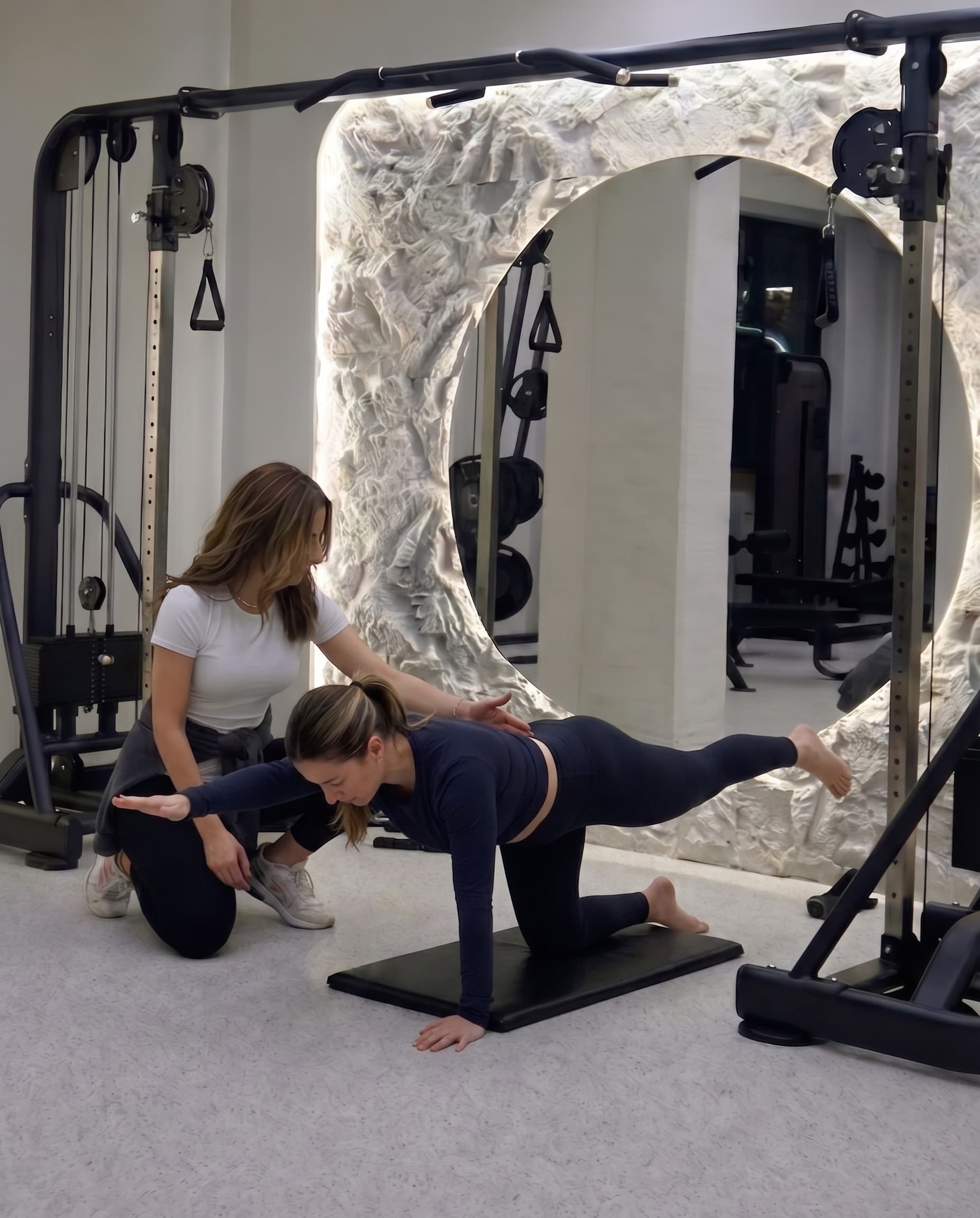
// NEUROMUSCULAR REPROGRAMMING & PRESSURE CONTROL
The LuKul Protocol: The End of Isolated Kegel Exercises
The commercial approach to postpartum exercise recovery dictates hundreds of isolated Kegel exercises. However, clinical biomechanics (Crawford et al.) proves that dynamic, multi-joint movements activate the Pelvic Floor Muscles (PFM) drastically more than static Kegels—the glute bridge by 56%, the lunge by 42%, and the squat by 30% more.
The pelvic floor does not function in a vacuum; it is designed to operate in synergy with the glutes, hamstrings, and diaphragm. This is why, within the LuKul matrix, we utilize heavy compound lifts as the powerful strength-restoration tool:
- Phase 1: Neuro-Respiratory Reset – Synchronizing IAP and "waking up" the transversus abdominis. In this early phase, Kegels are useful exclusively for re-establishing mind-muscle connection, not for building enduring strength.
- Phase 2: Postural Hip & Pelvic Correction – Returning the pelvis to a neutral position so the gluteal muscles can reclaim their mechanical function.
- Phase 3: Isometric Stabilization – The introduction of anti-rotational and anti-extension core protocols.
- Phase 4: Integrated Strength (Deadlift vs. Squat) – Clinical trials (Walsh, Skaug)
absolutely confirm that heavy resistance training (75-85% 1RM) does not damage the pelvic floor of
nulliparous or postpartum women, provided pressure control is maintained. We introduce load
strategically:
- The Deadlift (Hip Hinge): Introduced first. Because of the specific hip-hinge position where the hips are higher, it creates significantly less vertical compression on the pelvic floor compared to the squat. This is the safest movement for early-to-mid stage recovery, offering phenomenal posterior chain activation.
- The Squat: Introduced later. While it produces the highest peak activation of the pelvic floor muscles due to depth and gravity, the upright torso requires absolutely flawless IAP control to prevent pressure from being pushed downward (doming/coning).
Your body deserves reverence, not punishment.
If you have given birth in the last 12 months and wish to reclaim your strength without the risk of injury, request a private postural coaching assessment.
// CLINICAL REFERENCES & META-ANALYSES
- Crawford, et al. Pelvic floor muscle activation during compound weightlifting exercises vs isolated Kegel exercises. AJOG.
- Walsh, et al. (2025/2026). Concurrent pelvic floor muscle training and heavy resistance training in postpartum rehabilitation.
- Skaug, et al. (2024). Effect of heavy resistance training on pelvic floor muscle strength and resting pressure.
- Capoccia Giovannini, et al. (2026). Effectiveness of structured exercise programs on inter-recti distance reduction.
- Bigdeli, et al. (2025). Network meta-analysis of conservative interventions for Diastasis Recti Abdominis.
- Gluppe, et al. (2023). Effect of curl-ups on linea alba tension and inter-recti distance in postpartum women (RCT).
- Marnach, et al. / Clinical Guidelines. Postpartum serum relaxin levels, joint laxity duration, and high-impact exercise risk factors.