// INDEX_
Every time I load a new client's barbell beyond what she is accustomed to, I encounter the same instinctive fear: "Ljupka, I don't want to get bulky. I just want to lengthen and tone."
This fear is deeply rooted, but it rests on a fundamentally flawed conceptual framework. For decades, fitness magazines and commercial trainers have convinced women that heavy weights are exclusively for "mass," and that 3-kilogram dumbbells paired with endless cardio are the secret to a "toned" physique.
This is a biological fallacy. Muscle hypertrophy (growth) and atrophy (breakdown) represent a constant, dynamic biological "dance" within your body. Being "bulky" or "defined" has absolutely nothing to do with selecting a magical repetition range. The physiological truth is that every rep range "works" for every goal. The final result depends entirely on the intersection of three factors: mechanical tension, neurological fatigue, and your systemic caloric status. The outcome of relying on outdated, generic programs is clear: women spend hours in the gym, exhaust their nervous systems with empty repetitions, and their body composition remains identical.
As a Sports Scientist who spent years refining my craft in the elite systems of the Middle East (Kuwait) and learning directly from powerlifting legends (Stan Efferding, Ed Coan, Dr. Layne Norton), it is time to tell you the truth that will completely shatter your relationship with training: Strength will not make you massive. Weakness and poor nutrition will.
Deconstructing the Myth: The Biological Dance of Atrophy and Hypertrophy
What the fitness industry fails to mention is that hypertrophy and atrophy are not light switches; they are competing adaptations.
When you pick up a 4-kilogram weight and perform 30 repetitions, you are not shaping or "toning" the muscle. You are simply depleting glycogen, fatiguing slow-twitch (Type I) muscle fibers, and creating metabolic stress (what bodybuilders call "the pump").
The precise, aesthetically sharp look you are searching for is clinically referred to as myogenic tone. This is a state where the muscle maintains a high degree of firmness even at rest. The only way to build this tone is to force the nervous system to recruit high-threshold motor units (Type II fibers). And those only activate when the load on the bar is substantial.
Why You Won't Get "Bulky" (The Endocrinological Truth)
The fear of "massive muscles" stems from a fundamental misunderstanding of female endocrinology and the different mechanisms of muscle growth.
The Impossibility of Accidental Hypertrophy
- The Testosterone Deficit: Women naturally possess 10 to 20 times lower basal testosterone levels than men (0.5–2.5 nmol/L versus 10–35 nmol/L). While heavy strength training induces acute spikes in anabolic hormones in women, these elevations are minimal and return to baseline within 30 to 60 minutes. Your body is biologically incapable of massive hypertrophy without exogenous hormones.
- The Caloric Surplus: Muscle does not grow from tension in a vacuum. To become "massive," you must consume hundreds of calories above your maintenance level for months. If you are in a slight caloric deficit or at maintenance, heavy weights will exclusively condense you, preserving muscle tissue while you metabolize fat.
- Myofibrillar vs. Sarcoplasmic Adaptation: Sarcoplasmic hypertrophy is the bodybuilding method of "pumping" fluid into the muscle cell through massive volume. Conversely, myofibrillar hypertrophy, targeted by heavy loads, creates new, denser muscle fibers. The muscle becomes hard, armored, and exceptionally strong, without a drastic increase in circumference.
Empirical Proof: 170 kg on the Deadlift
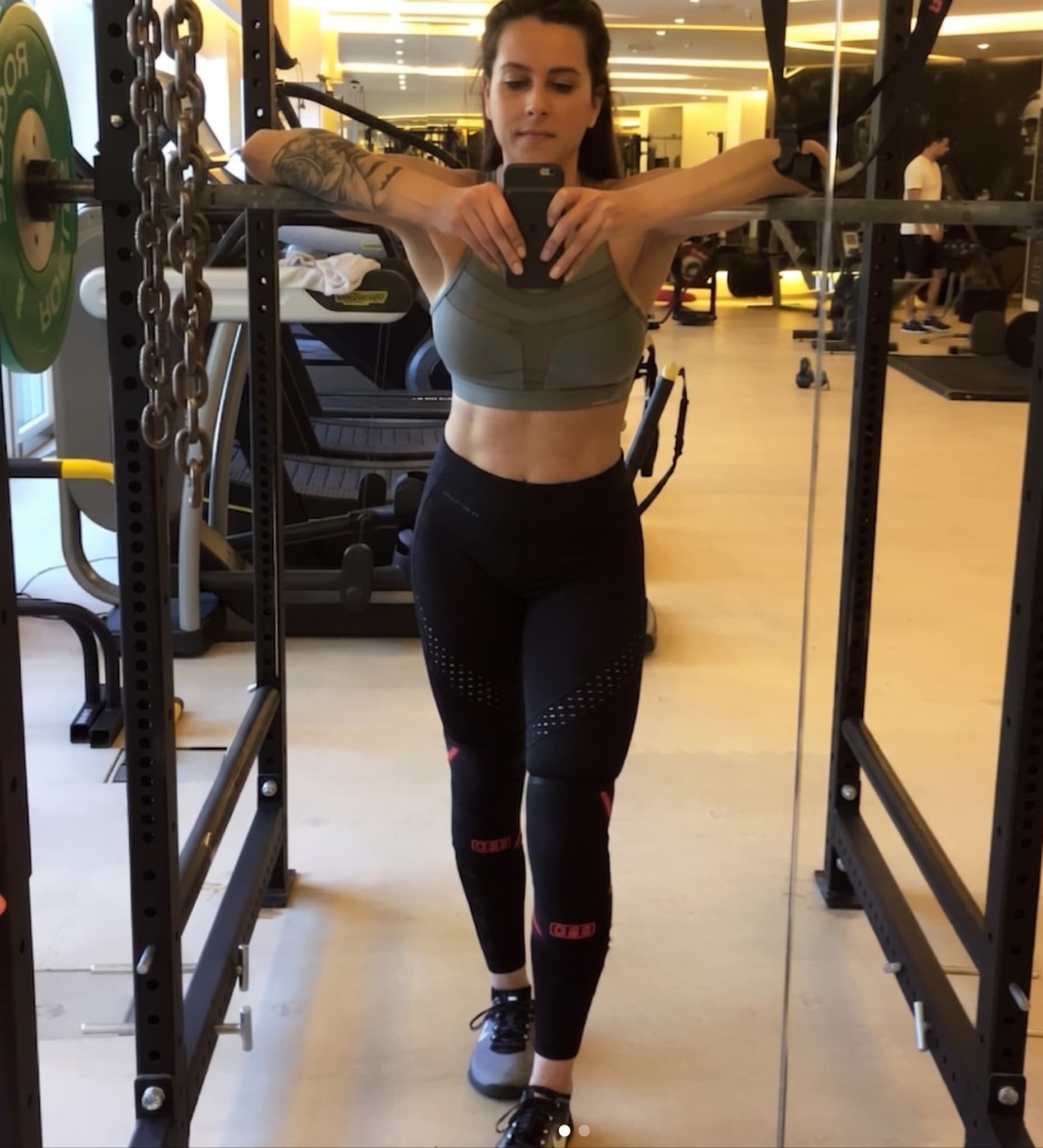
// Pulling 170 kg at a bodyweight of 63 kg
Theory sounds good, but in a sea of "personal trainers," empirical proof on one's own body is the ultimate metric of truth.
During my active powerlifting tenure (2012-2020), my central focus was raw strength, battling against the highest standards of elite competition. My personal records included:
- Deadlift: 170 kg
- Squat: 140 kg
- Bench press: 70 kg
According to standard fitness industry myths, a woman lifting nearly three times her own body weight from the floor should look like a heavyweight. The reality? I spent all those years competing in the 60 to 63-kilogram weight class.
My body did not become massive. It became highly functional, compact, and "armored" with muscle density that protects the joints. Constantly working at the absolute limits of the nervous system taught me how the female body actually responds to stress and why programming according to the menstrual cycle is the *only* way a woman can remain healthy under a heavy load. If 170 kilograms on the bar didn't turn me into a man, I guarantee that your 50 or 60-kilogram working squat will not make you bulky.
Ready to build a functional, resilient foundation?
Discard the pink dumbbells and generic programs. Request a consultation and begin a structured coaching protocol tailored to your biology.
Learn more about 1-on-1 MentorshipThe Clinical Impact of Heavy Loads on Female Physiology
Once you break through the psychological barrier and commit to adequate mechanical loading, a profound, systemic adaptation occurs that directly extends longevity:
- Osteogenesis & Osteoporosis Prevention: Women are biologically predisposed to bone mass degradation (osteopenia and osteoporosis). The commercial approach recommends light exercise, but this is a critical error. Recent meta-analyses prove that high-intensity strength training (loading 70% to 80% of 1RM) is absolutely essential to force the bones of the lumbar spine and hips to absorb calcium and increase in density. The landmark LIFTMOR trial definitively proved that heavy multi-joint movements, including the deadlift and squat, increase spine bone density by nearly 3%, with an impressive safety profile even in women with severe existing osteoporosis.
- The Metabolic Compensator: Muscle tissue is the most expensive currency in your body. The stronger you are, the better your body manages glucose, radically increasing insulin sensitivity and reducing visceral fat accumulation around the waist.
- Neuromuscular Efficiency & Posture: Heavy weights teach you how to forcefully "ignite" the nervous system and control the body under tension, successfully rehabilitating neurological inhibition (gluteal amnesia) caused by prolonged desk work (read how standard routines worsen this issue).
The LuKul Architecture: Menstrual Cycle Synchronization
Unlike generic commercial programs that place a barbell on a client's back on day one and demand the exact same output 365 days a year, the LuKul architecture respects the hormonal reality of the female body.
Recent systematic reviews of female physiology, such as the analysis by Niering et al. (2024), clearly demonstrate that the menstrual cycle dictates your strength and perceived fatigue. The early follicular phase is neurologically the weakest, while soaring estrogen levels during the late follicular phase and ovulation create the absolute peak of your isometric and dynamic strength. In the luteal phase, the surge in progesterone drastically increases core body temperature and perceived central nervous system fatigue.
This is why the LuKul system is divided into intelligent, adaptive phases:
- 1. Postural Assessment & Strength Restoration: Through 1-on-1 personal coaching, before you lift a single kilogram, we must "unlock" the joints and resolve asymmetries (which is critical for postpartum recovery and healing diastasis recti).
- 2. Baseline Mobility: Teaching the central nervous system to control the body through a full range of motion.
- 3. Strength Accumulation (Cycle-Synchronized): The progressive, controlled introduction of heavy loads. Based on your biology, we push for personal records (PRs) during the follicular phase when estrogen is anabolically dominant, while dropping total volume in the late luteal phase to protect the central nervous system from burnout.
- 4. Aesthetic Expression: Once a foundation of dense muscle mass and a powerful nervous system is established, caloric manipulation results in rapid, sharp somatic sculpting.
Generic Programming vs. LuKul Bio-Sync
| Standard Fitness Approach | LuKul Bio-Sync Methodology |
|---|---|
| Focus on fatigue and metabolic stress through endless repetitions with light weights. | Focus on neurological adaptation (myofibrillar hypertrophy) and bone density construction through progressive overload. |
| Complete ignorance of the menstrual cycle. The exact same approach every day, pushing for muscular failure at all costs. | Strict modulation of volume and load, mapped directly to estrogen peaks and energy drops in the luteal phase. |
| Overlooking postural degradation caused by desk work and postpartum anatomical changes. | Mandatory clinical rehabilitation of pelvic mechanics prior to heavy load exposure. |
Your Fears: Clinical Answers
Will lifting heavy weights make me bulky?
No. Due to a natural testosterone deficit and the absence of a massive caloric surplus, heavy weights build density and myogenic tone, not volume. The body becomes compact and armored, not bulky.
Is strength training safe after pregnancy?
Absolutely, but it must be specifically programmed. Postpartum strength training requires diastasis-aware postpartum strength preparation and pelvic floor fortification before progressing to heavy loads on the barbell.
How does strength training affect women in menopause?
Strength training is the only proven, non-pharmacological method to prevent bone loss (osteoporosis) and maintain a high metabolic rate despite the sharp drop in estrogen during menopause.
Strength is your biological privilege.
Stop wasting time on programs that underestimate your physical potential. Allow me to teach you how to become resilient, healthy, and aesthetically flawless.
// CLINICAL REFERENCES & LITERATURE
- Zhao, F., et al. (2025). Optimal resistance training parameters for improving bone mineral density in postmenopausal women: a systematic review and meta-analysis. Journal of Orthopaedic Surgery and Research.
- Watson, S., et al. (2019/2015). High-Intensity Resistance and Impact Training Improves Bone Mineral Density and Physical Function in Postmenopausal Women With Osteopenia and Osteoporosis: The LIFTMOR Randomized Controlled Trial. Journal of Bone and Mineral Research.
- Kerr, D., et al. (1996) / Nelson, M., et al. (1994). Exercise effects on bone mass in postmenopausal women are site-specific and load-dependent. Journal of Bone and Mineral Research.
- Niering, et al. (2024). Effects of Menstrual Cycle Phase on Maximum Strength and Muscle Fatigue: A Systematic Review and Meta-Analysis.
- McNulty, K., et al. (2020). The Effects of Menstrual Cycle Phase on Exercise Performance in Eumenorrheic Women: A Systematic Review and Meta-Analysis. Sports Medicine.
- Colenso-Semple, L., et al. (2023). Current evidence shows no meaningful effect of menstrual cycle phase on acute strength performance or adaptations to resistance training.
- Jansson, et al. (2022) / Kraemer, W., et al. Exercise training effects on anabolic and catabolic hormones in older adults: a systematic review and meta-analysis.
- Nindl, B., et al. (2001) / Marx, J., et al. (2001). Acute hormonal responses to resistance exercise in women. Journal of Applied Physiology.